If you wear glasses and have ever tried swimming without them, you'll know that underwater vision is blurry on two separate levels — the normal blurriness everyone experiences, plus your own uncorrected vision on top. Here's what's actually happening, and how to fix it.
Why Everyone’s Vision Is Blurry Underwater {#normal}
Even people with perfect eyesight see blurrily underwater without goggles. It’s a fundamental consequence of how the human eye works.
Your cornea provides about 70% of your eye’s total focusing power — and this focusing relies on the large difference in refractive index between air and corneal tissue. Air has a refractive index of 1.00. Your cornea: about 1.38. This big difference causes significant light bending, which creates focus.
Water has a refractive index of 1.33 — much closer to the cornea’s 1.38. When your eye is in water, the refractive index difference almost disappears, and so does the cornea’s focusing power. Light passes through the cornea almost unbent. The result: severe, unavoidable blurriness for everyone in water without goggles.
Why Glasses Wearers Have It Worse {#glasses-wearers}
People who need glasses have a vision condition — myopia, hyperopia, or astigmatism — that means their eye doesn’t focus light correctly even in ideal conditions. Glasses wearers underwater without correction experience two separate sources of blurriness:
- The universal corneal focusing problem (affects everyone)
- Their own uncorrected refractive error (their prescription)
The combined effect makes it difficult to see lane lines, other swimmers, pool edges, or the instructor at the side.
The Physics Explained Simply {#physics}
🔬 Numbers That Make It Real
Air refractive index: 1.00 · Water: 1.33 · Cornea: 1.38
Air-to-cornea difference: 0.38 — enough for proper focusing.
Water-to-cornea difference: 0.05 — almost no focusing at all.
This is why divers who wear contact lenses still report blurry vision underwater when their mask is flooded — and why goggles (which maintain an air pocket) immediately restore clarity.
What About Contact Lenses Underwater? {#contacts}
Contact lenses don’t solve the underwater blur problem. The same physics applies — water surrounding the contact lens changes its optical behaviour. More importantly, swimming with contact lenses carries a real infection risk from pool organisms like Acanthamoeba, which can cause serious eye infection.
The Solution — Prescription Goggles {#solution}
Prescription swimming goggles solve both sources of blurriness at once:
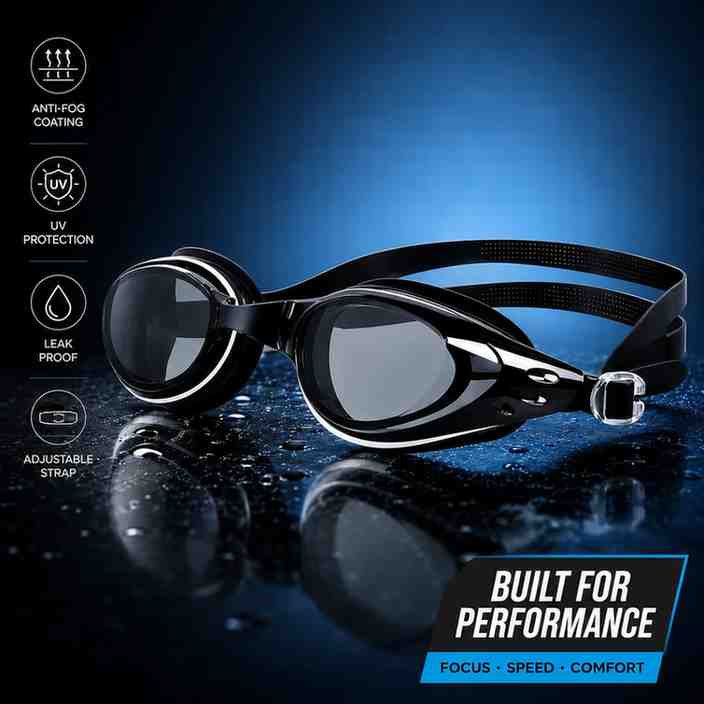
Stage 1: The goggle frame creates a sealed pocket of air in front of each eye. This restores the air-cornea interface, solving the universal underwater blur problem.
Stage 2: The corrective lens built into the goggle adds your specific prescription power — compensating for your myopia, hyperopia, or astigmatism.
How Prescription Goggles Fix Blurry Underwater Vision {#how-they-fix-it}
The goggle lens is shaped to a precise curvature matching your prescription. As light passes through it, it bends by exactly the right amount to correct your vision error. The lens operates in the air pocket inside the goggle — so the optical calculations work correctly, just as they do for glasses frames.
For most people, putting on well-fitted prescription goggles for the first time is genuinely surprising — the pool suddenly becomes sharp and clear in a way they haven’t experienced while swimming before.
Swim with Clear Vision
Custom prescription goggles made to your exact eye power. Adults and kids. No more squinting in the pool.
Adults Goggles Kids Goggles