If you wear glasses, you've probably wondered whether you can just wear them in the pool. The short answer is: technically yes, practically no. Here's why glasses don't work underwater — and what actually gives you clear vision while swimming.
The Short Answer {#short-answer}
You can wear glasses in a swimming pool, but they won’t help you see clearly — and they’ll almost certainly be damaged or lost. Even if they stay on your face, your vision underwater will still be blurry. The reason is physics.
Why Glasses Don’t Work in Water {#why-not}
Glasses work by refracting (bending) light as it passes through the lens before it reaches your eye. This calculation is based on the lens being surrounded by air on both sides.
When you submerge in water, several things change immediately:
- Water surrounds the glasses lens, not air
- Water has a much higher refractive index than air (1.33 vs 1.00)
- This changes the way light bends through the lens — your glasses are no longer correcting your vision accurately
- The water between your glasses and your eyes adds further optical distortion
The practical result: underwater with glasses on, your vision is blurry regardless of your prescription strength.
The Physics — Refraction and Water {#the-physics}
Vision underwater is blurry even for people with perfect eyesight — this is normal. The human eye is optimised to focus in air. When light passes from water into the eye, it bends differently because the refractive index of water (1.33) is much closer to that of the cornea (about 1.38) than air (1.00) is.
This means the eye’s cornea contributes almost no focusing power underwater. The result is severe blurriness for everyone.
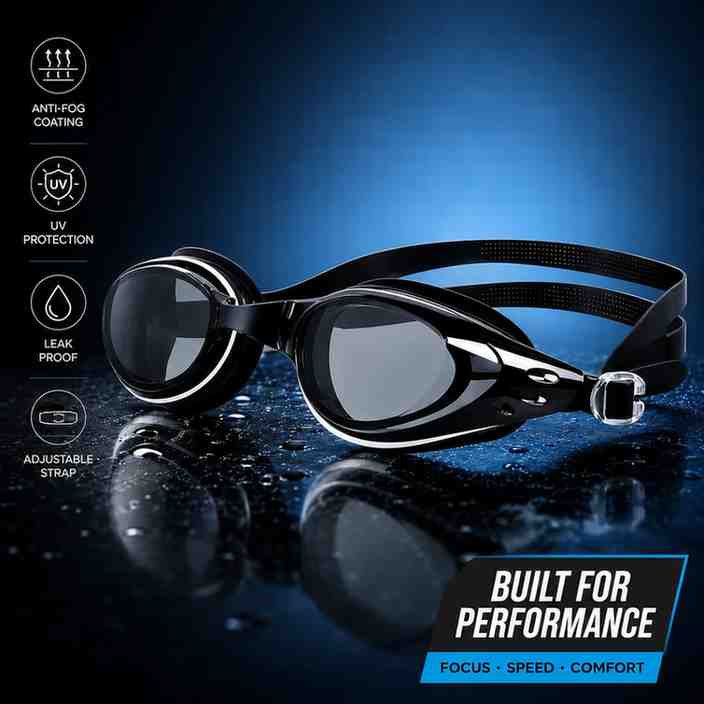
Regular swimming goggles solve this by creating a pocket of air in front of the eye, restoring the air-cornea interface. Prescription goggles add corrective power to additionally compensate for your vision condition.
🔬 Quick Science
Air-to-cornea = big refractive index difference = good focusing. Water-to-cornea = tiny difference = almost no focusing. This is why everything looks blurry underwater without goggles — for everyone, not just glasses wearers.
What About Contact Lenses? {#contacts}
Contact lenses correct vision, but wearing them in pool water is a genuine health risk. Pool water contains bacteria — including acanthamoeba — that can become trapped between the lens and the eye, causing serious infection including corneal damage.
Most ophthalmologists specifically advise against swimming with contact lenses. Contact lenses can also be dislodged in water, leaving you suddenly unable to see clearly mid-swim.
The Real Answer — Prescription Goggles {#real-answer}
Prescription swimming goggles are the only practical solution. They create a sealed air pocket in front of each eye, restoring your eye’s natural focusing — and add your specific corrective power on top for sharp, clear underwater vision.
Unlike glasses, they sit directly against your face with a waterproof seal. Unlike contact lenses, they carry no infection risk from pool water.
How to Get Prescription Swim Goggles {#how-to-get-them}
You need your current eye prescription and a supplier who makes goggles to your specific power. We make prescription swimming goggles for adults and children, matched to your exact prescription including astigmatism correction.
Swim with Clear Vision — Without the Risks
Prescription swimming goggles made to your exact eye power. For adults and kids.
Adults Goggles Kids Goggles